
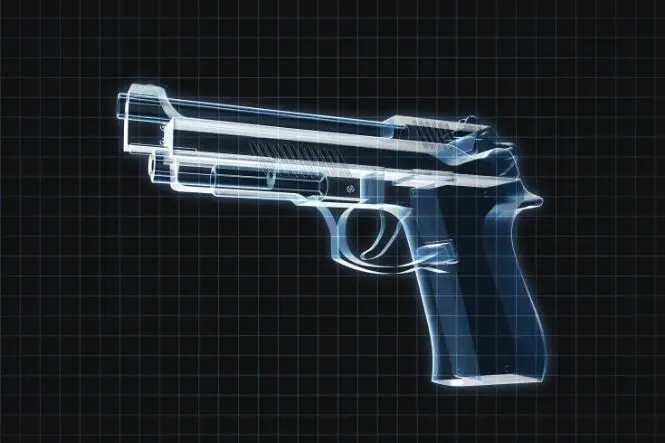
In a local story from 2008, a man in the UK received a jail sentence for taking replica guns and modifying them to functional firearms that ended up being used in 50 shootings. Eight of these shootings were ones that left a victim dead. The story has become an important one that represents the problem of banned weapons and the immense challenge faced by police and forensic scientists.
Banned Weapons And Imitation Weapons
The use of imitation weapons is banned in the UK, and it is a real challenge is for police and forensics experts to determine which ones could eventually be converted into operational firearms. Fortunately, research in this important area means that a new technique is currently in the works. The goal is to help police and forensic teams identify dangerous guns and protect the public from the uses and effects of these weapons.
Types of Replica Weapons
There are a couple of different kinds of replica weapons. The first are known as non-firing imitations, while the second replica weapons are blank-firing ones. The non-firing imitations will appear very similar to the firearm they are intended to replicate. However, these ones are generally not ones that can be modified to working firearms.
Weapons That Are Converted
The other kind – blank-firing weapons – can actually be converted. Normally, shells are volatile enough to act similarly to a gunshot but they don’t send a projectile. The barrel of the gun is comprised of tough alloys of an even density. Specific bits of the barrel can be drilled out to modify the weapon. The result is that these dangerous weapons can be used to commit crimes.
Finding The Differences
While it was previously challenging to determine the differences between the weapons, researchers employing the new technique utilised X-ray technology to send a beam via the barrels of unconvertible imitation and conversion imitations. Afterwards, the researchers analysed the X-ray absorption of the metal as X-ray energy was raised.
For the barrels that can be converted, the visual plot of the results is typically linear, but for the unconvertible ones, plots were quite chaotic and scattered. In this way, it was relatively simple to see which barrels had conversion potential. The technique is still in its developmental stages but the results thus far show promise for discerning potentially convertible guns from non-convertible ones.
Protecting The Public
As mentioned, the case in 2008 of a British man converting firearms – eight of which later killed individuals while 50 were used in shootings – shows that the conversion of legal weapons into banned ones is a key issue in the police force. The new study could prove valuable in helping us determine which weapons are potentially dangerous ones. In this way, it is hoped that future shootings and deaths can be prevented, making it safer for all of us in Britain and elsewhere in the world.